
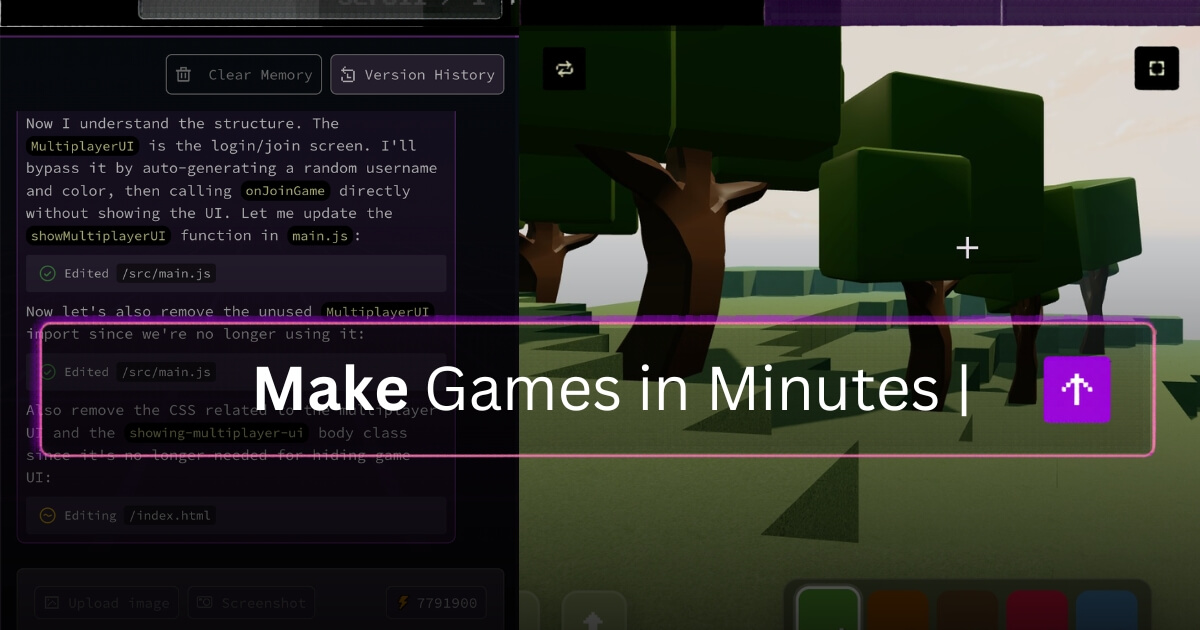
Rosebud
Rosebud helps non-technical founders build 2D/3D game prototypes using AI-assisted vibe coding and Three.js.
Type
AI Game Builder / Vibe Coding Platform
Pricing
Freemium
Category
AI Game DevelopmentWebsite
Rosebud.aiMVPable Score
Solid for game prototyping and validation, but you'll hit walls if you need anything beyond Three.js
Reviewed by MVPable · Updated
Who Should Use Rosebud
Use Rosebud if
- Non-technical founders prototyping a casual game concept fast
- Solo creators testing a game mechanic or idea before hiring a dev team
- Indie devs who want a quick Three.js prototype without boilerplate setup
- Founders building a playable demo for investor pitches or crowdfunding
Avoid Rosebud if
- Teams building production-quality mobile or console games
- Founders who need native game engines like Unity or Unreal capabilities
- SaaS or non-game MVPs — this is purpose-built for games only
- Developers who need full control over rendering pipelines, physics, or multiplayer networking
Real use cases
Casual browser game prototype
Build a simple puzzle, clicker, or arcade game playable in the browser to test whether your game concept resonates with players. Share the link, collect feedback, iterate.
Playable pitch demo for investors
Create a functional 3D game demo using Three.js to accompany your pitch deck. Not production code, but enough to show the core loop and get people excited.
Educational or gamified experience MVP
Build an interactive 3D learning experience or gamified product walkthrough. Think: a branded mini-game or an educational simulation you can embed on a landing page.
Game jam entry or rapid concept test
Spin up a game in hours for a jam or to quickly validate a weird idea. The AI-assisted workflow lets you move faster than writing Three.js from scratch.
Rosebud Review: What You Need to Know
What Rosebud Actually Does
Rosebud is a vibe coding platform specifically built for making games. You describe what you want in natural language, and it generates game code — specifically using Three.js for the visual layer. It's designed for people who aren't traditional game developers but have game ideas they want to bring to life.
The key word here is games. This isn't a general-purpose app builder. If you're building a SaaS dashboard or a marketplace, close this tab. But if you're trying to validate a game concept without spending months learning Unity, Rosebud is worth a serious look.
Where It Excels
The speed-to-playable ratio is genuinely impressive. You can go from "I want a 3D platformer where you collect crystals" to something you can actually play in a browser within a day or two. For non-coders, that's a massive unlock. You're not dealing with game engine installation, asset pipeline setup, or build configurations. You describe, it builds, you tweak.
Three.js as the rendering backbone is a smart choice — it means everything runs in the browser, which is perfect for sharing prototypes via URL. No app stores, no downloads. Send someone a link, they're playing your game. That feedback loop is exactly what you need during validation.
Where It Falls Short
Here's the thing: Three.js is a JavaScript 3D library, not a game engine. You're getting rendering and basic interaction, but you're not getting a robust physics system, audio engine, animation state machines, or networking out of the box. If your game concept needs any of those things at a serious level, you'll start fighting the tool instead of building with it.
The AI-generated code can also be a black box. When it works, it's magic. When it doesn't, debugging AI-generated Three.js code without deep JavaScript knowledge can be painful. You're in this middle ground where you don't need to code, but you might need to understand code to fix things.
The platform is also narrowly scoped. That's fine if you know you're building a game, but there's no pathway to add user accounts, leaderboards, payments, or backend logic natively. You'll need to bolt those on separately.
Honest MVP Take
Rosebud is a legitimately useful tool for one specific job: getting a playable game prototype in front of people fast. If you're a founder with a game concept and zero game dev experience, this gets you from zero to testable faster than any alternative short of hiring someone. But treat it as a prototyping tool, not your production stack. The game that ships on Steam or the App Store will need to be rebuilt in a real engine. Use Rosebud to figure out what to build, then build it properly.
What most reviews don't mention
Three.js is the only rendering option — you can't switch to Phaser, PixiJS, or a native engine within the platform
No built-in multiplayer, backend, or database support — if your game needs user accounts or leaderboards, you're on your own
AI-generated code quality varies significantly — simple games work well, but complex game logic can produce buggy or hard-to-debug output
Browser-only output means performance ceilings for 3D-heavy games — don't expect console-quality visuals or 60fps on complex scenes
Unclear code export/ownership story — verify whether you can fully extract and own the generated code before building anything serious
MVPability Score
Rosebud vs Alternatives
Market positioning
Rosebud sits in a niche between no-code game makers (like GDevelop) and full AI coding assistants (like Cursor). It's specifically optimized for the intersection of AI code generation and Three.js game development.
vs. Alternatives
Gambo.ai targets a similar audience but the two platforms differ in their approach to game templates and AI generation style — worth trying both side by side. For more serious 2D games, GDevelop or Construct give you more control without code. If you're comfortable with code and just want AI assistance, using Cursor or Copilot with a proper game framework (Phaser, Three.js directly) gives you more flexibility at the cost of more setup.

How we'd use it in a real MVP workflow
A serious team would use Rosebud purely for rapid concept validation — build 3-5 playable prototypes in a week, test them with real users, identify which core loop works, then rebuild the winner in Unity, Godot, or a custom Three.js stack. Think of it as your game design sketchpad, not your production codebase.
Key trade-off
Rosebud trades depth and control for speed and accessibility. You'll prototype faster than almost any other path, but the Three.js-only constraint and AI-generated code quality mean anything beyond a simple game prototype will require a rebuild in a proper engine.
Frequently asked questions
Can I build a real, shippable game with Rosebud?
You can build a playable browser game, yes. But if 'shippable' means App Store, Steam, or a polished commercial product, you'll almost certainly need to rebuild in a proper game engine. Rosebud is best for proving your concept works, not for final production.
Do I need any coding knowledge to use Rosebud?
Not to get started — the AI handles code generation from natural language. But when things break or you want specific behavior, some JavaScript/Three.js knowledge helps enormously. Pure non-coders will hit frustration points on anything beyond simple games.
Can I export the code and use it outside Rosebud?
This is something you need to verify directly with Rosebud before committing. Since the output is Three.js code, it should theoretically be portable, but platform-specific abstractions or dependencies could complicate a clean export. Check their terms and test an export early.
How does Rosebud compare to using Claude Code or Cursor to write game code?
Rosebud is purpose-built for games, so the AI understands game concepts (sprites, collision, game loops) better out of the box. With ClaudeCode or Cursor, you get more flexibility but need to set up your own project, handle dependencies, and debug more. Rosebud trades flexibility for speed.
Is the free tier enough to validate a game idea?
For a basic prototype, likely yes. The freemium model should let you build and test a simple game. Expect to hit limits on generation frequency, project complexity, or hosting if you need to iterate heavily or share widely. Budget for a paid tier if you're serious about testing with real users.
Ready to see how Rosebud fits in your MVP stack?