
Imbue Sculptor
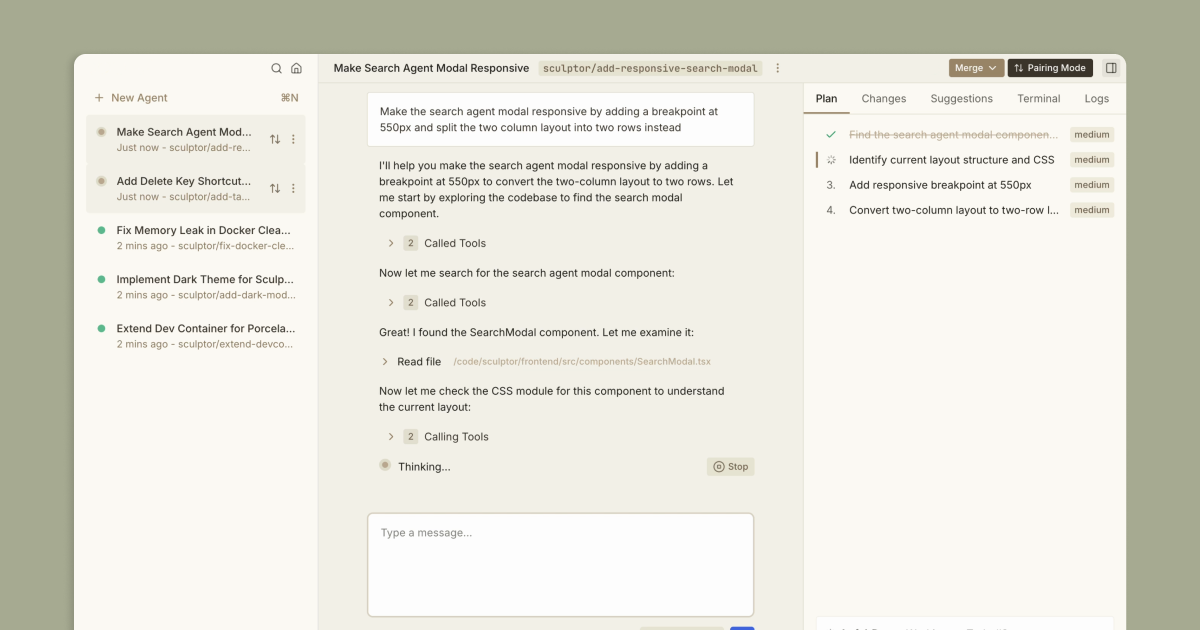
Imbue Sculptor gives developers a visual UI to run multiple Claude Code agents in parallel, safely containerized.
Type
AI Code Generation / Developer Workflow Tool
Pricing
Freemium
Category
AI Code GenerationWebsite
imbue.comMVPable Score
A power-user multiplier for Claude Code fans, but not a standalone MVP builder
Reviewed by MVPable · Updated
Who Should Use Imbue Sculptor
Use Imbue Sculptor if
- Technical founders already using Claude Code who want to parallelize coding tasks
- Solo devs building multi-feature MVPs who want to work on 3-5 things simultaneously
- Teams doing rapid prototyping sprints where multiple components need scaffolding at once
- Developers who want container isolation for AI-generated code before merging into their main project
Avoid Imbue Sculptor if
- Non-technical founders looking for a no-code/low-code builder — this assumes you can code
- Founders who haven't used Claude Code before — this is an enhancement layer, not a starting point
- Teams that need a full deployment pipeline — Sculptor generates code, it doesn't ship products
- Projects where you need tight real-time collaboration — this is more of a solo orchestration tool
Real use cases
Parallel feature scaffolding for a SaaS MVP
Spin up 5 Claude agents to simultaneously build your auth flow, dashboard UI, Stripe integration, email service, and API routes. Review and merge the outputs into your IDE when each finishes.
Rapid API + frontend prototype
Have one agent build your REST API while another scaffolds a React frontend and a third writes tests. Pull them together in your IDE for integration testing.
Exploring multiple architectural approaches
Not sure whether to use Next.js App Router vs Pages, or Express vs Fastify? Run parallel agents building the same feature with different stacks, compare the outputs, and pick the winner.
Refactoring and migration tasks
Point multiple agents at different modules of your codebase for refactoring — one handles database queries, another updates component patterns, a third migrates tests. Safer because each runs in its own container.
Imbue Sculptor Review: What You Need to Know
What Sculptor Actually Does
Imbue Sculptor is essentially a GUI orchestration layer on top of Claude Code. If you've used Claude Code from the terminal and thought "I wish I could run five of these at once without them stepping on each other," that's exactly the pitch. Each agent runs in its own container, so if one goes off the rails, it doesn't trash your working directory. You can monitor all of them visually, then bring the outputs into your IDE.
Where It Excels
The parallelism is the killer feature. When you're building an MVP, you typically have 5-10 distinct chunks of work — auth, payments, core feature, admin panel, email, etc. Normally you'd context-switch between them or feed them to Claude Code sequentially. Sculptor lets you dispatch all of them at once and stay in a review/merge flow instead of a generation/wait flow. The container isolation is genuinely useful — it means each agent has a clean sandbox, reducing the risk of one agent's hallucination breaking another's work.
The "bring into your IDE" workflow matters too. You're not locked into some proprietary editor. You generate in Sculptor, then pull the code into VS Code, Cursor, or whatever you actually use. That's the right abstraction for developers who care about their tools.
Where It Falls Short
First, this is an enhancement to Claude Code, not a replacement for knowing how to code. If you can't evaluate the output, five bad outputs in parallel is worse than one bad output you're carefully reviewing. The tool amplifies your throughput but also amplifies the review burden.
Second, you're tightly coupled to Anthropic's Claude models. If Claude Code's quality dips, or if pricing changes significantly, your entire workflow is affected. You're stacking dependencies — Imbue's orchestration layer on top of Anthropic's API.
Third, the tool is still relatively early. Imbue is primarily an AI research company, and Sculptor feels like a product that emerged from their internal tooling. That's both a strength (built by people who actually use it) and a risk (unclear product roadmap, unclear long-term commitment to this as a standalone product).
Honest MVP Take
If you're a technical founder who's already comfortable with Claude Code, Sculptor can legitimately 3-5x your throughput during the initial build phase of an MVP. You'll knock out the boilerplate and scaffolding fast, then spend your time on integration and the parts that actually make your product unique. But it's a velocity multiplier, not a product builder. You still need to know what you're building, how to review AI output, and how to ship it. Think of it as a power tool, not a factory.
What most reviews don't mention
You're paying for Claude Code API usage per agent — running 5 agents in parallel means 5x the API costs, which can add up fast during heavy iteration
Container orchestration adds complexity — if Sculptor's container layer has issues, debugging becomes a layer-cake problem (is it Claude's output, Sculptor's orchestration, or a container config issue?)
The tool's longevity is uncertain — Imbue is an AI research lab, not a developer tools company. Sculptor could be deprioritized if their research direction shifts
Merging outputs from multiple parallel agents into a coherent codebase still requires significant manual work — the agents don't coordinate with each other, so you may get conflicting patterns or duplicate utilities
Limited community and ecosystem — compared to Cursor or Copilot, you'll find very few tutorials, templates, or community support for Sculptor-specific workflows
MVPability Score
Imbue Sculptor vs Alternatives
Market positioning
Sculptor sits in a unique niche — it's not competing with Cursor or Copilot for in-editor assistance, but rather offering a parallel orchestration layer for Claude Code specifically. It's closer to a DevOps-flavored AI workflow tool than a traditional code assistant.
vs. Alternatives
Compared to Augment Code, Sculptor is more developer-controlled and less opinionated about your workflow, but lacks Augment's codebase-aware context. Versus Zed's AI features, Sculptor offers parallelism that Zed doesn't, but Zed gives you a tighter editor-integrated experience. Cursor is probably the closest mainstream competitor in spirit, but Sculptor's multi-agent parallel approach is genuinely different — it's batch processing vs. pair programming.



How we'd use it in a real MVP workflow
A serious team would use Sculptor in the first 1-2 weeks of an MVP sprint to rapidly generate and scaffold the major components — auth, API routes, database models, basic UI screens — running parallel agents for each. Then they'd shift to their regular IDE (Cursor, VS Code) for integration, testing, and the nuanced product logic that requires human judgment. Sculptor is a sprint tool, not a daily driver.
Key trade-off
Sculptor trades simplicity for throughput. You'll generate code faster, but you'll also spend more on API costs, deal with merge complexity across parallel outputs, and add a dependency on a relatively early-stage tool from a research lab. Best used as a sprint accelerator, not a permanent workflow fixture.
Frequently asked questions
Do I need a Claude Code subscription to use Sculptor?
Yes. Sculptor is a UI layer on top of Claude Code, so you need access to Claude's API. Your costs scale with how many agents you run and how long they work. Running 5 agents in parallel means 5x the token usage.
Can I use Sculptor with models other than Claude?
Based on available information, Sculptor is built specifically around Claude Code agents. There's no indication it supports other LLMs like GPT-4 or Gemini. You're locked into the Anthropic ecosystem.
Is the code output actually production-quality?
It's as good as Claude Code's output, which ranges from decent scaffolding to occasionally wrong. The parallel approach doesn't improve quality per agent — it improves throughput. You still need to review everything carefully before shipping.
How does the container isolation actually work?
Each Claude agent runs in its own sandboxed container, meaning it can write files, install packages, and execute code without affecting your local environment or other agents. You pull the results into your project when you're satisfied. This is genuinely safer than running AI code generation directly in your working directory.
Is this better than just using Cursor or Claude Code directly?
Different tool, different use case. Cursor is great for in-editor pair programming. Claude Code in terminal is great for single-threaded task execution. Sculptor is for when you want to batch-dispatch multiple independent tasks and review them afterward. If your MVP has lots of parallel-ready work, Sculptor saves time. For iterative, conversational coding, Cursor is still better.
Ready to see how Imbue Sculptor fits in your MVP stack?