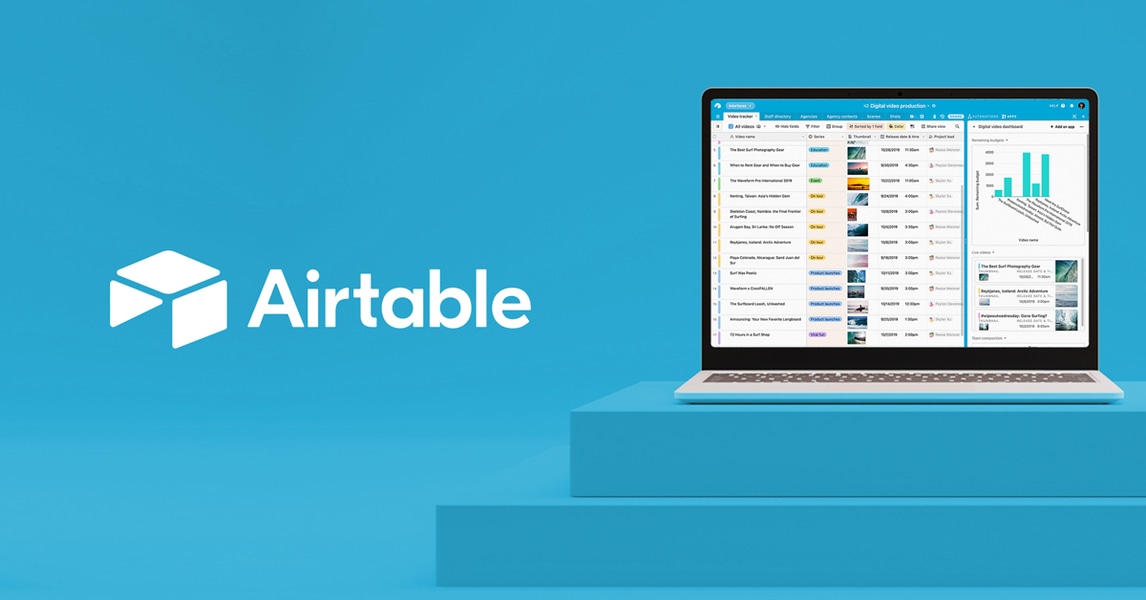

Airtable
Airtable helps non-technical founders build data-driven apps, directories, and internal tools without writing code.
Type
No-code platform with AI/vibe coding interface
Pricing
Freemium
Category
AI Code GenerationWebsite
airtable.comMVPable Score
Excellent for data-centric MVPs and directories, but you'll outgrow it fast if your product needs real application logic
Reviewed by MVPable · Updated
Who Should Use Airtable
Use Airtable if
- Non-technical founders building directory or marketplace MVPs
- Teams needing an internal tool or CRM-like app in days, not weeks
- Solo founders validating a data-heavy idea (job boards, vendor lists, inventory trackers)
- Content or operations teams building lightweight apps without engineering support
Avoid Airtable if
- SaaS products requiring custom authentication, user roles, or complex backend logic
- Founders building consumer-facing apps that need polished UI and fast load times
- Products that will need to handle 100K+ records or high-throughput workflows
- Teams who want to own their codebase and avoid vendor lock-in from day one
Real use cases
Local business directory MVP
Build a filterable directory of businesses (like a niche Yelp) using Airtable as both database and front-end. Use their Interface Designer or new vibe coding features to create a public-facing view. Add forms for submissions.
Internal operations dashboard
Stand up a tool for your team to track orders, manage vendor relationships, or handle customer onboarding. Link tables, add automations for Slack notifications, and build views per team member.
Marketplace listing MVP
Create a two-sided marketplace (like a freelancer directory or equipment rental board) where suppliers submit via forms and buyers browse via filtered interfaces. Use automations to notify matches.
Content calendar / editorial tool
Build a content pipeline tracker with status fields, assignees, due dates, and linked assets. Use Airtable's calendar and Kanban views to manage workflows. Ship it to a small editorial team in hours.
Airtable Review: What You Need to Know
What Airtable Actually Is Now
Airtable started as a spreadsheet-database hybrid — think Google Sheets with superpowers. Over the years it's evolved into something more interesting: a no-code app builder where the database is the product. Recently, they've added a vibe coding interface that lets you describe what you want in plain English and generates working views and logic. It's a meaningful upgrade for non-coders.
Where It Genuinely Excels
If your MVP is fundamentally about structured data — a directory, a tracker, a catalog, a CRM — Airtable is hard to beat for speed. You can go from idea to a functional, shareable product in a day. The relational database is intuitive (linked records between tables work the way your brain expects), and the built-in views (grid, kanban, calendar, gallery) mean you get multiple UI layouts for free.
The new AI/vibe coding features are legitimately useful. You can describe an interface or automation in natural language, and Airtable will scaffold it. It's not magic — you'll still need to tweak — but it collapses the learning curve significantly. For a non-technical founder, this is where Airtable now competes with tools like Cursor or Figma Make, just from a very different angle.
Automations are the other underrated feature. Trigger workflows on record changes, send emails, hit webhooks, push to Slack. For an MVP, this can replace a lot of backend logic you'd otherwise need to code.
Where It Falls Short
Here's the honest truth: Airtable is a database pretending to be an app. The moment your product needs real application-level concerns — user authentication, role-based access beyond basic sharing, complex conditional logic, fast page loads for thousands of users — you're going to hit walls.
The 50,000 record limit per base on lower plans is a real constraint. If your directory or marketplace takes off, you'll feel this fast. The API rate limits (5 requests per second) will also bite you if you're building anything that integrates heavily with external services.
The front-end experience for public-facing apps is okay, but it looks and feels like Airtable. Your users will know. If brand experience matters to your MVP thesis, this is a limitation.
The Real Talk
Airtable is ideal for a specific founder profile: you're non-technical, your MVP is data-centric, and you need to test demand before investing in a real build. It's not where you build your startup — it's where you validate whether your startup is worth building. Use it to prove the concept, collect early users, and gather data. Then rebuild in something you own.
Don't try to make Airtable into something it's not. It's not a SaaS platform. It's not a consumer app builder. It's the fastest way to get a structured-data product in front of real users, and for that specific job, it's excellent.
What most reviews don't mention
50,000 records per base on free/Plus plans — you'll hit this faster than you think with a directory or marketplace MVP
API rate limit of 5 requests/second per base makes real-time integrations and heavy automation workflows unreliable at scale
No real code export — everything you build lives inside Airtable's ecosystem. If you migrate, you're rebuilding from scratch with only your data (CSV export)
Interface Designer pages are not indexable by search engines — terrible for SEO-dependent products like directories
The 'vibe coding' interface is promising but still early — complex logic often requires manual intervention and understanding of Airtable's scripting extension
MVPability Score
Airtable vs Alternatives
Market positioning
Airtable sits between pure no-code tools (like Softr or Glide) and AI code generators (like Cursor or Figma Make). It's strongest when your product IS a database with views on top.
vs. Alternatives
Compared to Zed or Kiro, Airtable requires zero coding ability but gives you far less control over the final product. Figma Make lets you design a polished UI and generate code — Airtable doesn't care about pixel-perfect design but gets you to a working data app faster. If you need a proper front-end, pair Airtable as a backend with Softr or Glide instead of using its native interfaces.



How we'd use it in a real MVP workflow
A serious team would use Airtable as a rapid validation layer: build the directory or tracker in a weekend, drive real traffic to it, and measure engagement. Once you've proven demand, treat the Airtable base as your data spec — export the schema and records, then rebuild the product in Supabase + Next.js (or whatever your real stack will be). Don't try to scale Airtable into production.
Key trade-off
Airtable gives you unmatched speed for data-centric MVPs but locks you into their ecosystem with no code export. Plan your migration path before you start — the longer you build on Airtable, the more painful the eventual rebuild.
Frequently asked questions
Can I build a real SaaS product on Airtable?
Not really. You can build SaaS-like internal tools, but Airtable lacks proper user authentication, subscription billing, and role-based access at the level a real SaaS needs. Use it to validate the idea, then rebuild.
Is the free plan enough to validate an MVP?
Yes, for most cases. You get 1,000 records per base, 1GB of attachments, and basic automations. That's enough to test a directory with a few hundred listings or an internal tool for a small team. You'll need to upgrade ($20/user/month) if you get traction.
How does the new vibe coding / AI interface compare to tools like Cursor?
They're solving different problems. Cursor generates real code you own. Airtable's AI helps you configure Airtable faster — building interfaces, writing formulas, setting up automations via natural language. It's great for non-coders but you're still building inside Airtable's walled garden.
Can I use Airtable as a backend for a custom front-end?
Yes, and many people do. Airtable has a REST API, and tools like Softr, Glide, and Pory are built specifically to put polished front-ends on Airtable data. Just watch the API rate limits — 5 requests/second won't handle serious traffic without caching.
Will investors take my Airtable MVP seriously?
At the pre-seed stage, investors care about traction, not stack. If your Airtable MVP has real users and revenue signals, it works. But technical investors will expect you to have a plan to rebuild. Nobody's raising a Series A on Airtable.
Ready to see how Airtable fits in your MVP stack?